
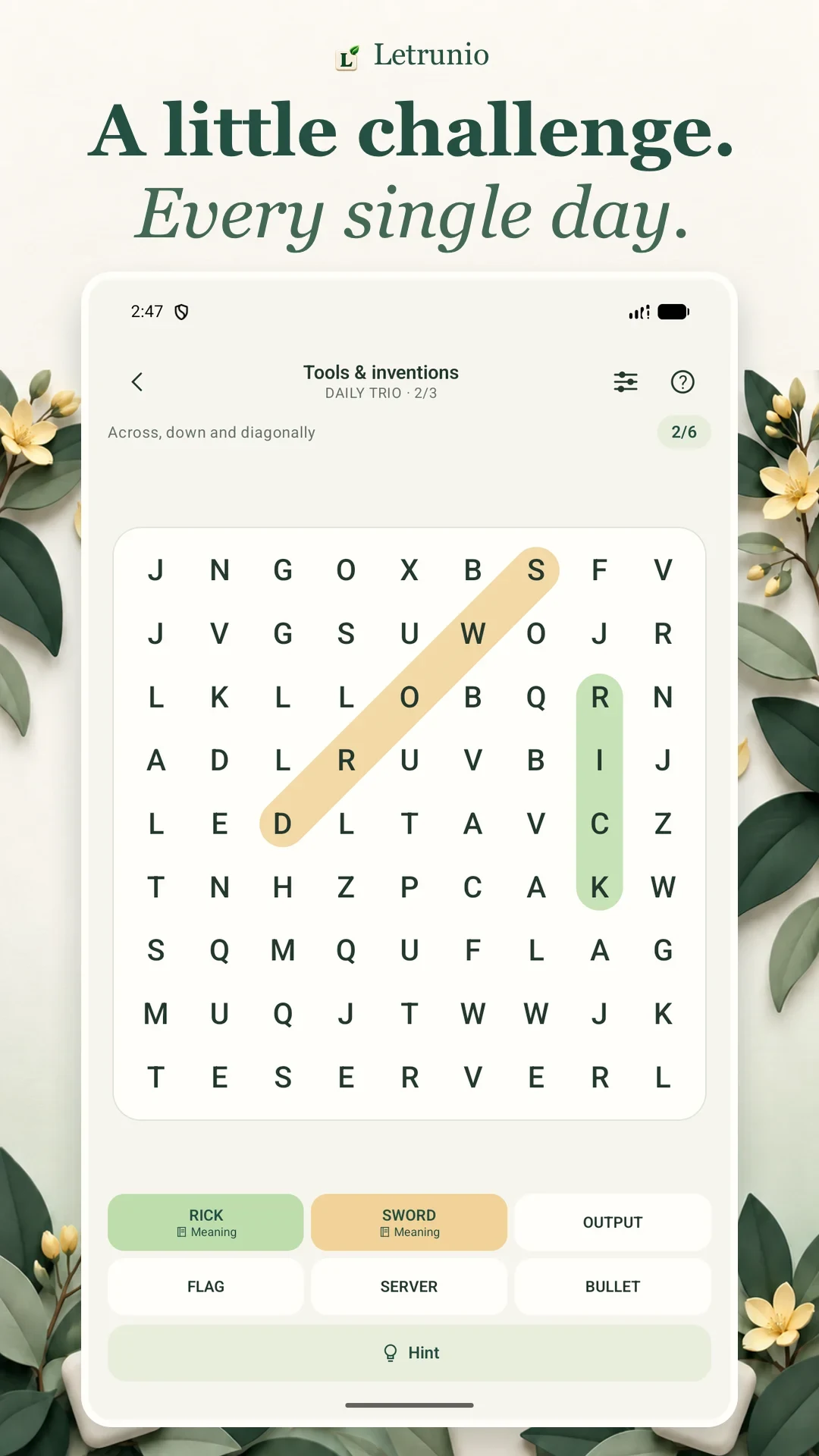
A useful word search strategy is to choose one target, look for a matching pair of letters, and check the allowed directions from that point. If you get stuck, switch to a systematic scan rather than looking at the same patch of letters again.
These tips are for puzzles with hidden words in a letter grid. They are not crossword clue-solving techniques. You can use the same approach on paper or try it in Letrunio.
1. Choose a target before scanning
Read the list once and pick a word. A short word or a spelling you recognise immediately can be a comfortable starting point. You do not have to hold every target in your head at the same time. Once one is marked, choose the next and repeat the process.
2. Search for a letter pair
Suppose the target is PLANT. Instead of stopping at every P, look for a P with an L next to it. If there is no L in an allowed direction, rule that starting point out. When P and L match, continue along the same line to check A, N, and T.
If the opening pair appears often, try a more distinctive pair elsewhere in the word. You can trace back from that pair to test the whole spelling. A matching fragment is a clue, rather than a complete answer.
3. Check the puzzle’s directions first
Not every word search uses every direction. In Letrunio, the direction label above the grid tells you what to expect for the current puzzle. There is little reason to check every diagonal on a board that only contains horizontal and vertical targets.
Keep a consistent order: rows, columns, diagonals if enabled, and reverse directions if enabled. Whatever the direction, a word follows one straight line. It cannot bend around another word or turn a corner to reach the final letter.
4. Scan rows in a fixed order
If your eyes keep returning to the same few squares, start at the top row and work across it. Then move to the next row. Finish that pass before changing the target or switching to a column scan.
This will not reveal every word immediately, but it gives your search a clear starting point and a clear end. Include the corners and edges; they are easy to skip when you jump between the most visually crowded parts of the grid.
5. Break diagonals into single steps
For a diagonal word, each next letter moves one row and one column. If your first step is down and right, repeat that exact step all the way through the word. If the next matching letter is somewhere else, it is not on the same diagonal.
Also count how much space is left before the edge. A six-letter word needs six squares along its line. When a possible direction runs out of squares too soon, you can eliminate it without checking every remaining letter.
6. Keep highlighted squares in play
Words can overlap. A square used by a word you have already found may also belong to a remaining target. Do not mentally remove highlighted letters from the board. If your next letter pair appears inside a coloured line, check it just as you would an unmarked pair.
7. Confirm the ending square before selecting
Seeing the right word and selecting it precisely are separate steps. If a selection is rejected, check whether you stopped one square past the final letter. Drag along the line from start to finish. In Letrunio, tapping the first and last letters in sequence is another way to make a controlled selection.
When should you use a hint?
Try one deliberate scan before using a hint. Afterwards, look at the word’s direction and the letter pattern you missed. You can look for that pattern in your next puzzle. There is no need to treat every board as a speed contest.
Put one strategy into practice
On your next puzzle, choose a single target and use the first-two-letters method. In Letrunio, you can then open the found word’s meaning and save it to your collection. Explore the game or download it from Google Play and the App Store.
Choose your next guide
- How to Play Word Search: A Beginner’s Guide
- Word Search with Definitions: Letrunio’s Word Collection
Read this guide in Turkish: Kelime Bulmaca Taktikleri: Yatay, Dikey ve Çapraz.